Jl. Dewi Sri IV No.4, Legian. BALI

Contact Fabio Visa Agency Bali for Indonesia Visa and KITAS Application

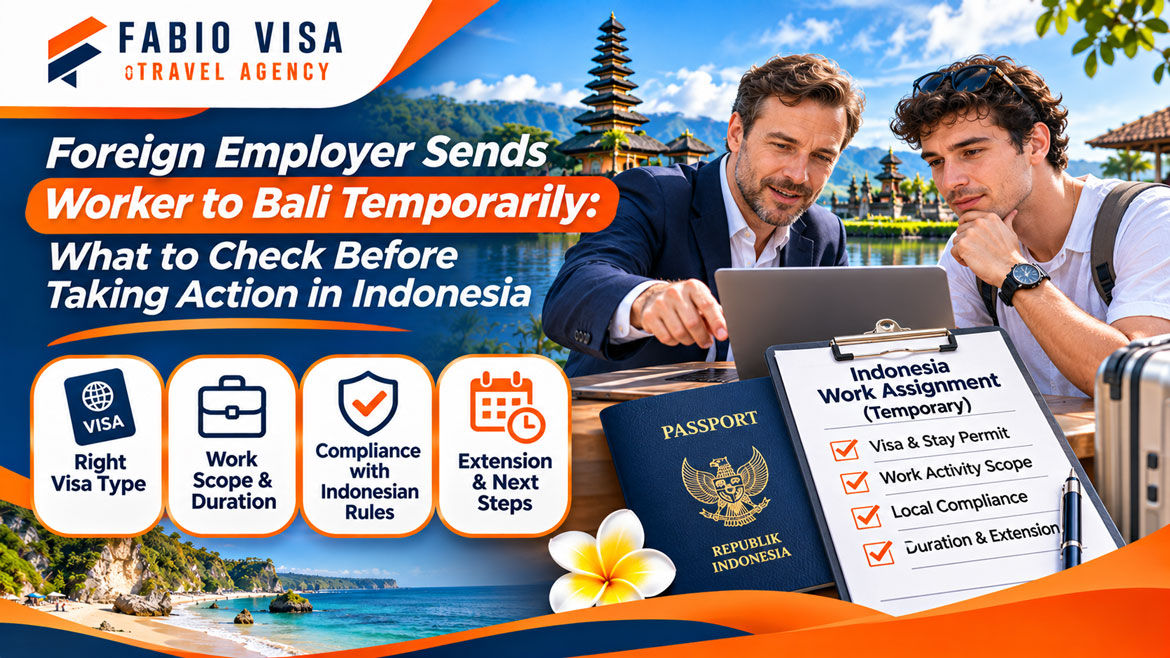
Bali is increasingly becoming a destination for international business activities, professional assignments, technical projects, and corporate collaboration. While the island is widely recognized for tourism, foreign companies also send employees to Bali for meetings, project supervision, training, equipment installation, and temporary operational assignments.
However, sending a foreign employee to Bali for a temporary work assignment requires more preparation than booking a flight and arranging accommodation. Even when an employee remains on a foreign company’s payroll, Indonesian immigration and employment regulations may still apply depending on the activities performed.
A common misunderstanding is that short assignments automatically qualify as business visits. In reality, the distinction between attending meetings and performing productive work can significantly affect the type of visa and authorization required.
Before sending an employee to Indonesia, foreign employers should evaluate the assignment’s purpose, duration, local business relationships, and applicable immigration requirements. This guide explains the essential considerations for companies planning temporary employee assignments in Bali.
International businesses frequently move employees between countries to support projects and maintain operations. A company headquartered in Australia, Singapore, the United Kingdom, or another country may need to send a specialist to Bali for a few days or several months.
The employee might be responsible for inspecting a project, training local personnel, reviewing business operations, or assisting an Indonesian partner. Although these activities may appear similar from a business perspective, they can fall under different immigration classifications.
Indonesian immigration rules distinguish between permitted business visits and activities requiring appropriate work authorization. The duration of the assignment is important, but it does not independently determine whether a business visitor visa is sufficient.
Employers should therefore examine what the employee will actually do in Indonesia rather than relying only on the job title or length of the trip.
One of the first questions foreign employers should address is whether the assignment involves business meetings or actual work performed in Indonesia.
Business visits may include certain activities such as attending meetings, discussing commercial agreements, negotiating contracts, or exploring potential partnerships. These activities may be permitted under an appropriate business visit visa, subject to the conditions of the selected category.
Working activities are different. They may involve providing technical services, carrying out operational responsibilities, performing installations, or delivering professional services to an Indonesian business.
For example, a foreign sales director attending meetings with a Bali-based distributor may have different visa requirements from an engineer sent to install industrial equipment at the distributor’s facility.
Employers should not assume that describing an assignment as a business trip automatically makes all planned activities permissible under a business visit visa.
Some international companies assume that employees do not need Indonesian work authorization because their salaries continue to be paid overseas. This assumption can create compliance risks when the employee performs activities that Indonesian regulations classify as work.
The source of salary is only one factor in evaluating an international assignment. Immigration authorities may also consider the nature of the activities, the organization benefiting from the work, the location where services are performed, and the applicable visa conditions.
For instance, a software specialist employed by a company in Singapore might travel to Bali to assist an Indonesian customer with a system implementation. Even if the employee receives no salary from an Indonesian entity, the assignment may still require a visa or authorization appropriate for the services being performed.
Foreign employers should review the actual assignment before deciding whether a business visit arrangement is suitable.
Indonesia provides several visa categories for foreign nationals entering the country for different purposes. The appropriate category depends on the employee’s activities, eligibility, sponsorship arrangements, and intended duration of stay.
A business visit visa may be appropriate for certain non-employment business activities. However, an employee undertaking technical work, operational responsibilities, or other regulated professional activities may require a different authorization.
For assignments involving employment in Indonesia, a working limited-stay visa and related employment authorization may be necessary. Certain short-term professional or technical activities may also have specific visa classifications, depending on the applicable regulations.
Employers should verify the permitted activities under the current Indonesian visa classification system rather than selecting a visa solely because it offers a convenient duration of stay.
The official Indonesian immigration e-Visa platform provides information about available categories and their conditions. Where employment authorization is involved, the relevant manpower regulations must also be considered.
Sponsorship is another important consideration when planning a temporary assignment.
Depending on the visa category, an Indonesian company or another eligible sponsor may need to support the application. The sponsor may be required to provide business documentation, explain the purpose of the assignment, and fulfill applicable immigration responsibilities.
For example, an overseas engineering company sending a technician to support an Indonesian customer may need to coordinate with the local contracting company regarding the appropriate sponsorship arrangement.
However, not every Indonesian business relationship automatically creates eligibility to sponsor foreign workers. The proposed sponsor must satisfy the requirements applicable to the relevant visa or employment authorization.
Employers should establish who will be responsible for sponsorship before submitting an application or confirming the employee’s travel schedule.
When an assignment qualifies as employment involving a foreign worker in Indonesia, employers may need to comply with Indonesia’s foreign manpower regulations.
An important element is the Rencana Penggunaan Tenaga Kerja Asing (RPTKA), which is the foreign worker utilization plan. Depending on the employment arrangement and applicable exemptions, the relevant employer may need to obtain RPTKA approval before the foreign worker begins the authorized activity.
Certain assignments may also involve compensation fund obligations, commonly associated with the Dana Kompensasi Penggunaan Tenaga Kerja Asing (DKPTKA).
The requirements depend on the legal arrangement, the employee’s position, and the applicable regulations. Employers should not assume that every short-term assignment is exempt from manpower obligations.
Because immigration permission and employment authorization serve related but distinct purposes, both aspects should be reviewed before the employee travels.
Temporary assignments can last several days, several weeks, or several months. The appropriate immigration arrangement should cover the expected activities and duration without exceeding the authorization granted.
For example, a foreign technical consultant may need to spend three weeks in Bali assisting with a specific project. Another employee may be assigned for six months to supervise an operational transition.
These situations can involve different documentation, sponsorship, and authorization requirements.
Employers should also account for possible project delays. If the assignment extends beyond its original schedule, additional immigration procedures or a different authorization may become necessary.
Planning for reasonable scheduling uncertainty can help companies avoid situations in which employees remain in Indonesia without appropriate permission.
A well-prepared assignment letter can help explain the employee’s purpose of travel and responsibilities. Although document requirements vary by visa category, employers should prepare accurate information describing the assignment.
The letter may identify the employee’s name, employer, position, destination, assignment dates, and specific activities to be performed. It should also explain the relationship between the overseas employer and any Indonesian company involved.
Additional supporting documents may include employment contracts, business agreements, company registration information, professional qualifications, and relevant sponsorship documents.
The information should be consistent across the visa application and supporting records. Employers should avoid using vague descriptions that conceal technical or operational work.
Clear documentation allows the proposed activities to be assessed against the appropriate immigration requirements.
Technical assignments are particularly important because they can be mistaken for ordinary business visits.
Consider an Australian equipment manufacturer that sells machinery to a hotel development project in Bali. The manufacturer plans to send an engineer for two weeks to install the equipment and train the local maintenance team.
Although the visit is short, the engineer will perform technical activities rather than merely attend commercial meetings.
Depending on the precise scope of work, a specific visa and applicable employment authorization may be required. The company should clarify whether installation, testing, maintenance, or training activities are covered by the intended immigration permission.
A similar assessment may be necessary for foreign specialists working on information technology systems, production equipment, construction projects, or professional consulting assignments.
Remote working arrangements introduce another consideration for international employers.
An employee may wish to remain in Bali temporarily while continuing to perform online duties for an overseas company. Indonesia provides a remote worker visa category, commonly identified as E33G, for eligible foreign nationals meeting the applicable conditions.
However, this arrangement should not be confused with authorization to work for an Indonesian employer or provide unrestricted services to Indonesian customers.
For example, an employee working remotely for an overseas company may have different requirements from a consultant physically delivering services to a Bali-based client.
Employers should evaluate the location of the business activities, contractual arrangements, eligibility requirements, and restrictions of the relevant visa.
The fact that work is performed on a laptop does not automatically establish that every visa category is appropriate.
Using a visa that does not authorize the activities performed can expose both the individual and the organizations involved to immigration or employment compliance problems.
Depending on the circumstances, consequences may include administrative penalties, cancellation of immigration permission, deportation, or restrictions affecting future entry into Indonesia.
Business disruption is another concern. An employee who cannot legally continue an assignment may be unable to complete an installation, project inspection, or scheduled operational activity.
For foreign companies, this can affect contractual obligations, project deadlines, and relationships with Indonesian business partners.
The most effective approach is to verify the applicable requirements before the assignment begins rather than attempting to resolve an immigration issue after the employee has already started working.
Immigration is not the only consideration when assigning employees to Indonesia.
Depending on the arrangement, foreign employers may also need to evaluate Indonesian tax obligations, contractual responsibilities, employment compliance, and potential business presence issues.
For example, a temporary employee assignment could raise questions about whether services are being provided to an Indonesian customer, whether the overseas company has local reporting obligations, or whether the assignment creates additional tax exposure.
These questions depend on the relevant facts and applicable laws. Holding an appropriate visa does not automatically resolve corporate or tax obligations.
Companies should coordinate immigration planning with qualified legal, employment, and tax advisers where necessary.
Foreign employers coordinating temporary assignments to Bali may find Indonesian visa procedures unfamiliar, particularly when the assignment involves technical activities or potential employment authorization.
Fabio Visa Agency provides immigration assistance for international travelers, professionals, and businesses planning activities in Indonesia. Its services include business visa assistance, Working KITAS arrangements, and other relevant immigration services.
Companies looking for guidance on visa bali requirements can contact Fabio Visa Agency to discuss the employee’s intended activities, assignment duration, and potential documentation needs.
For example, an overseas employer preparing to send a technical specialist to Bali may need assistance understanding whether the proposed assignment is consistent with a business visit category or requires further work authorization review.
Fabio Visa Agency can help explain its available visa application services and relevant administrative procedures. Where specialized employment or legal interpretation is necessary, the employer should also seek advice from appropriately qualified professionals.
Final visa decisions and employment authorizations remain the responsibility of the relevant Indonesian government authorities.
Can a foreign company send an employee to Bali for two weeks without a work permit?
The answer depends on the activities performed and the applicable visa category. A short assignment does not automatically qualify for exemption from work authorization requirements, particularly when the employee performs technical or operational services.
Can an employee attend business meetings in Bali on a business visa?
Certain business visit visa categories permit activities such as attending meetings and discussing commercial arrangements. However, the employee must remain within the activities authorized by the specific visa.
Does an employee need Indonesian work authorization if paid overseas?
Payment from a foreign employer does not automatically remove Indonesian immigration or manpower requirements. The actual work activities and applicable regulations must be assessed.
Can an Indonesian customer sponsor a foreign employee?
Sponsorship may be possible under an appropriate arrangement, but the Indonesian organization must meet the requirements for the relevant visa or employment authorization. The correct structure should be confirmed before applying.
Can Fabio Visa Agency help with temporary assignments?
Fabio Visa Agency offers business visa and Working KITAS assistance. Foreign employers can contact the agency to discuss available services and identify the information needed for an initial assessment.
Sending an employee to Bali temporarily can be an effective way to support international projects, maintain business relationships, and provide specialized expertise. However, foreign employers should not treat every short business trip as an activity that automatically qualifies for a standard business visit visa.
The most important consideration is the actual work the employee intends to perform. Employers should review the assignment’s purpose, duration, sponsorship requirements, and potential employment authorization obligations before confirming travel arrangements.
Careful preparation can reduce compliance risks, avoid unnecessary project interruptions, and help employees enter Indonesia under an immigration arrangement appropriate for their responsibilities.
If your company is preparing to send an engineer, consultant, technical specialist, or corporate employee to Bali, the most important step is to establish what that person will actually do after arriving. A short visit for meetings may involve different immigration requirements from an assignment involving equipment installation, client services, or operational responsibilities. Making this distinction early can help your company avoid unsuitable visa applications and costly changes to project schedules.
Fabio Visa Agency can assist with an initial discussion about the proposed assignment and its available business visa or Working KITAS services. Before contacting the team, prepare a brief description of the employee’s duties, nationality, expected arrival date, assignment duration, and the Indonesian company involved. These details can help identify the immigration questions that need to be addressed before travel, including whether additional employment authorization advice is necessary.
Explain your company’s planned assignment and ask the team to review the available visa assistance options before you finalize international flights or commit to a project start date. Taking this step while the assignment is still being organized can help your business approach its Bali operations with greater clarity and fewer avoidable administrative complications.